Transmission Repair vs. Replacement: Which Is Better for Your Car?
It starts with a subtle hesitation when you shift into drive. Perhaps it’s a faint burning smell after your commute through Boca Raton traffic, or a jarring “thud” as your vehicle moves between gears. These are the whispers of a transmission in distress. For many drivers, the word “transmission” is synonymous with “expensive,” and the anxiety that follows a diagnostic warning can be overwhelming.
At Boca Auto Service, LLC, we believe that knowledge is the best antidote to automotive anxiety. Your transmission is essentially the central nervous system of your vehicle, responsible for translating the engine’s power into the movement that carries you down the road. When it fails, you are faced with a critical fork in the road: do you repair, rebuild, or replace?
Making the right choice isn’t just about the immediate bill; it’s about the long-term health of your vehicle and the safety of your family. Since 1980, our veteran and family-owned shop has helped thousands of drivers navigate this exact dilemma with honesty and transparency.
The Lifeblood of Your Vehicle: Understanding Transmission Health
To understand the repair vs. replacement debate, we first have to talk about viscosity and heat. Transmission fluid acts as both a lubricant and a coolant. Over time, heat: especially the intense Florida heat we experience in Boca Raton: breaks down this fluid. It loses its ability to protect the intricate gears and seals inside the unit.
When the fluid loses its protective properties, friction takes over. Small metal shavings can begin to circulate, acting like sandpaper on internal components. This is why we often refer to routine maintenance as an “insurance policy.” A simple fluid flush is a minor investment compared to the catastrophic consequence of a total system meltdown.
If you suspect trouble, the first step is always a professional evaluation. You can learn more about how we pinpoint these issues in our guide on car diagnostics and how mechanics identify problems before they get expensive.

Option 1: Transmission Repair (The Targeted Solution)
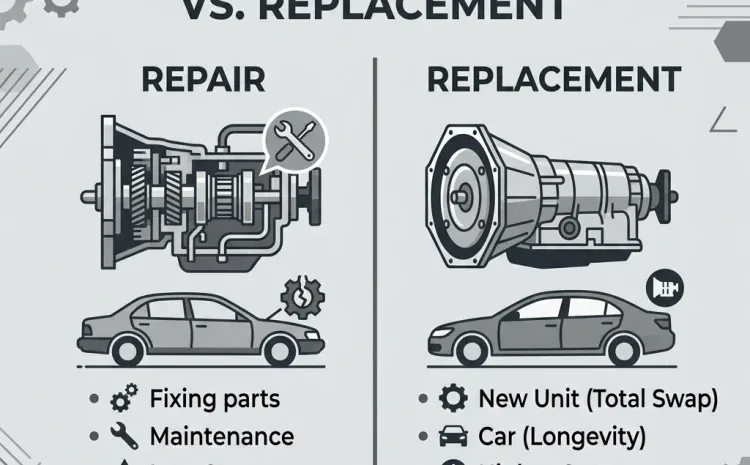
Transmission repair is the most surgical approach. This option is ideal when the problem is localized to a specific, accessible component rather than a failure of the entire internal gear set.
Common repairs include:
- Replacing a Solenoid: These are electro-hydraulic valves that control fluid flow. If one fails, you might experience “limp mode” or specific gear failures.
- Fixing External Leaks: Replacing a pan gasket or a front seal can prevent fluid loss that would otherwise lead to total failure.
- Sensor Replacement: Modern transmissions rely on speed sensors to communicate with the car’s computer.
The Pros:
- Cost-Effective: Typically ranging from $300 to $1,500, this is the most budget-friendly route.
- Speed: These repairs can often be completed in a single day.
- Preservation: You keep your original factory components that are still in good working order.
The Cons:
- It only fixes the “symptom” if the underlying cause is deeper wear and tear. If your transmission has high mileage, a minor repair might just be a bandage on a larger wound.
Option 2: Transmission Rebuilding (The Middle Ground)
When the damage is internal but the main housing of the transmission is still sound, a rebuild: or “overhaul”: is often the recommended path. During a rebuild, our ASE-certified technicians completely disassemble the unit. Every part is inspected. Friction surfaces, seals, gaskets, and filters are replaced with brand-new components.
This is a labor-intensive process that requires a high level of expertise. At Boca Auto Service, we leverage over 40 years of experience to ensure that every “hard part” (like the gear sets and shafts) is within factory specifications before the unit is reassembled.
The Pros:
- Value: It costs significantly less than a brand-new unit (typically $3,500 – $7,500) but provides a “like-new” internal state.
- Customization: We can often install upgraded parts that address known factory weaknesses in specific vehicle models.
The Cons:
- Time: Because of the precision required, a quality rebuild can take several days to a week.
- Risk: If the technician isn’t highly skilled, small errors in reassembly can lead to premature failure. This is why choosing a shop with a legacy of honest, transparent service is vital.

Option 3: Transmission Replacement (The Total Refresh)
Sometimes, the internal damage is so severe that the metal housing itself is warped or the internal “hard parts” are shredded. In these cases, transmission replacement is the only logical safeguard.
There are two types of replacements:
- Remanufactured Transmissions: These are units that have been sent back to a factory setting, stripped down, and rebuilt to original equipment manufacturer (OEM) standards. They often come with the best warranties.
- Used Transmissions: Sourced from salvage yards. While cheaper, we generally advise caution here as the history of the unit is unknown.
When is replacement better?
If your vehicle is relatively new but suffered a catastrophic mechanical failure, a remanufactured unit provides the ultimate peace of mind. It effectively resets the clock on your drivetrain.
For high-mileage vehicles, you must weigh the cost of replacement (up to $10,000 in some luxury models) against the total value of the car. If the repair cost exceeds the car’s value, it may be time to consider a different vehicle. However, in today’s market, keeping a well-maintained car running is often a smarter financial “investment” than a new car payment.
Why Experience Matters in Transmission Diagnostics
You wouldn’t want a general practitioner performing heart surgery; the same logic applies to your car. Transmissions are incredibly complex mechanical “harmonies” of hydraulics and electronics.
Choosing a shop for transmission repair in Boca Raton shouldn’t be based on the lowest quote alone. It should be based on integrity. Since opening our doors in 1980, Boca Auto Service, LLC has maintained a reputation for telling customers what they need, not just what makes the most money. Our ASE-certified team uses state-of-the-art diagnostic tools to ensure we aren’t recommending a full replacement when a simple sensor repair would suffice.
Whether it’s a standard commuter car or a high-performance vehicle, we treat every car as if it were our own. That is the standard of a veteran and family-owned business.

Decision Matrix: Repair or Replace?
To help you decide, ask yourself these three questions:
- What is the overall condition of the car? If your engine is strong and you’ve recently invested in suspension service or new tires, the vehicle is worth saving.
- How long do you plan to keep the vehicle? If you need another five years out of the car, a replacement or high-quality rebuild is the way to go. If you’re looking to trade it in soon, a targeted repair might be sufficient.
- What is the warranty? Always look for the warranty behind the work. A rebuilt or replaced transmission should come with a guarantee that protects your investment.
Conclusion: Don’t Ignore the Warning Signs
Ignoring a transmission issue is like ignoring a leak in a dam: it will only get bigger and more expensive. If you notice slipping, delayed engagement, or unusual noises, the time to act is now. Early intervention is the difference between a $500 repair and an $8,000 replacement.
At Boca Auto Service, LLC, we are proud to be your go-to experts for auto repair in Boca Raton. We provide the honest, transparent guidance you need to keep your car on the road for years to come.
Don’t let transmission trouble stall your life. Contact us today for a professional diagnostic and experience the difference that 40+ years of dedicated service makes.
Ready to get your car back in gear?
Contact the experts at Boca Auto Service, LLC today or visit us to see why we’ve been Boca’s trusted mechanics since 1980.
